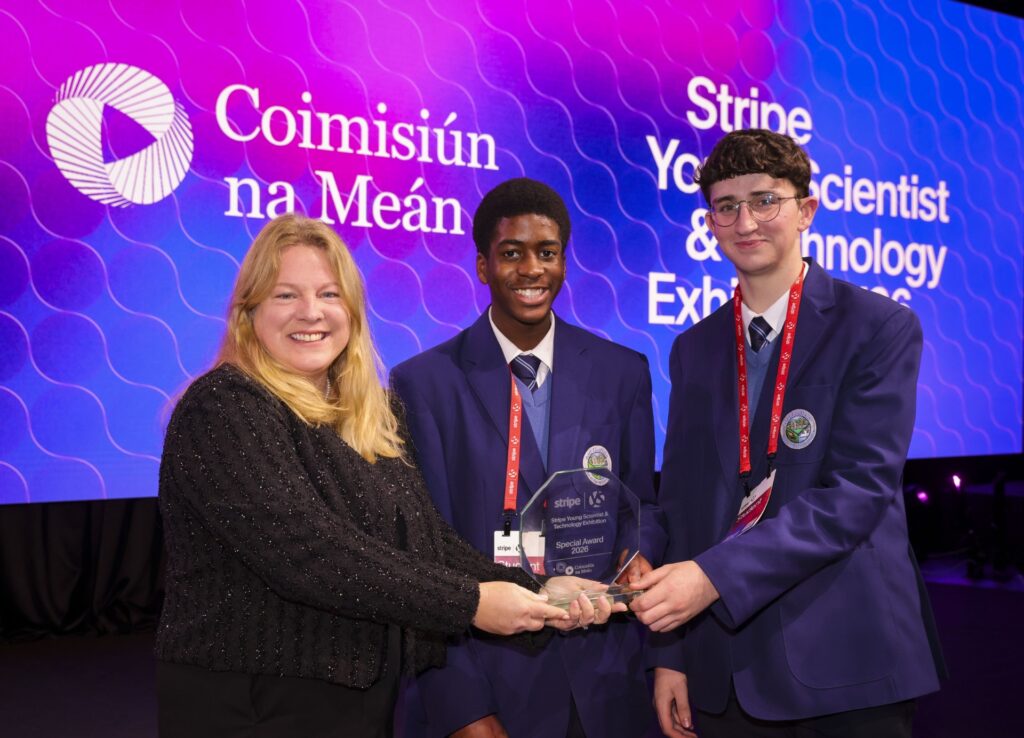
by Shane and Willard, winners of the Coimisiún na Meán Award at the Stripe Young Scientist and Technology Exhibition 2026
We are currently in Transition Year, which means we have the option, and often the time, to participate in many extracurricular activities we would not normally do, such as the Stripe Young Scientist and Technology Exhibition (YSTE), which we both think was a great decision!
We were thrilled to win both a special prize from Coimisiún na Meán and to come second place in our category. For us, this is one of the highlights of TY that we will remember for a long time. YSTE was a great experience that we would recommend to all students.
Our project
Our project was called ‘The Mask of Masculinity’, and it explored the following question: How does toxic masculinity present itself in the lives of young people?
Firstly, toxic masculinity refers to ‘a set of attitudes and ways of behaving, stereotypically associated with or expected of men, regarded as having a negative impact on men and on society as a whole’. We chose this topic as we know that it is a topical issue, which we see countless examples of in our everyday lives – whether it’s on social media, through influencers, on TV shows like Adolescence, or even in sport.
One interesting study we found was by the University of South Carolina. It aimed to uncover the negatives of toxic masculinity. The study found that toxic masculinity caused ‘emotional detachment’ and the suppression of vulnerable emotions to avoid being seen as ‘weak’ or ‘soft’. This led to different negative mental health effects like depression and a higher risk of suicide.
Methodology
We conducted a survey and a social media analysis to investigate the levels of toxic masculinity with a focus on young people, schools and social media. We surveyed a total of 1,044 students from eight different single-sex schools and eight different co-educational schools across multiple counties. The purpose of our survey was to investigate toxic masculine attitudes in teenage males in a single-sex boys’ school and a co-educational school. Our hypothesis was that toxic masculine attitudes would be more common in the predominantly all-male environments, like the single-sex boys’ schools.
Those surveyed were given statements on emotions, gender stereotypes, roles and other characteristics of toxic masculinity. They were then asked if they agreed or disagreed with them (ratings on a scale of 1–5). For example, ‘men should be the protectors of and defend their family’ and ‘men should act strong even if they feel scared or nervous’, which indicates emotional suppression. The questions were based on previous surveys and studies that define and identify toxic masculine characteristics.
School survey results
We found that toxic masculine attitudes were, in fact, more common in the single-sex boys’ schools, which we learned to be statistically significant when we carried out the T-Test. Our survey highlighted that some ‘symptoms’ of toxic masculinity were more often found in single-sex boys’ schools, such as reluctance to express emotions or seek external help when feeling sad, depressed or anxious. One of our most surprising results was that there is a gap in education, as only 49.52% of all students in both school types knew what toxic masculinity was. Of those who knew, only an average of 53.5% could identify toxic masculinity when exposed to it on social media.
Social media analysis and findings
Today’s world is strongly shaped by the online world, but social media doesn’t always create a healthier and more supportive environment. Therefore, to combat these negative attitudes and behaviours, we must know more about them, so we again asked ourselves how toxic masculinity presents itself in the lives of young people.
We found in our survey that TikTok was the main social media platform, which led us to our social media analysis. This involved creating six TikTok accounts that replicated those of a teenage male, showing us how vulnerable they are to online content. We based this experiment on one carried out by the DCU Anti-Bullying Centre. The major difference in our experiment was that we did not interact with the toxic masculine videos (i.e. likes, comments, etc.).
We found that on all six accounts, after a maximum of 58 scrolls, toxic masculine content was suggested to us. On each account, the toxic masculine content started with male body image and increased in frequency until the accounts were being suggested to contain misogynistic, racist or homophobic content. We used previous studies to determine if a video featured toxic masculine content, often using features like hashtags and keywords. We took note of recurring hashtags on toxic masculine posts, such as #masculinity. One of our findings that surprised us was that under #masculinity, 33 out of the first 40 posts had toxic masculine traits and characteristics. Under the hashtag #masculinity, repetitive themes included violence, misogyny, promotion of rigid gender roles, body image and emotional suppression, which are all characteristics of toxic masculinity. We also took note of recurring influencers such as Andrew Tate, which we found interesting, as it shows that even when an influencer is banned, the spread of their content persists.
Key learnings
If we were to continue our project in the future, we would like to investigate whether a larger sample size or even locality (rural or urban) could affect results. In our social media analysis, we would also consider comparing the frequency of toxic masculine content on other social media platforms, like the DCU study, but with the newer algorithms that favour watch times rather than user interactions, leading to different results.
Overall, our research also shows that change is possible. Many young people reject harmful ideas of toxic masculinity, like violence, emotional suppression and rigid gender roles. With better education, more positive role models and smarter algorithms, we can create an online environment that supports healthier, more open and more equal ideas of masculinity. This project has made it clear that the future of masculinity doesn’t have to be toxic. With awareness and action, it can be something far more positive for everyone.