MLI and EDMO Ireland delivered the second Disinformation Forum on 11 May 2026 entitled Countering Disinformation through Media Literacy Collaborations: From national strategies to community enablers.
Each Disinformation Forum is designed around the needs of a specific sector. This Disinformation Forum successfully brought together over 35 participants from a wide range of stakeholders from the Community and Voluntary sectors, as well as media literacy and counter disinformation practitioner, infrastructure and policy stakeholders.
The National Counter Disinformation Strategy (NCDS) sets out Ireland’s policy response to disinformation. It outlines a series of commitments designed to promote a whole-of-society approach to building resilience against false and misleading information.
Among these, Commitment 4 calls for Ireland to adopt a lifelong approach to empowering all citizens with the skills and confidence to critically engage with media, recognising the need for sustained and inclusive efforts across all age groups, sectors, and communities.
Under this Commitment, at least one forum per year on ‘Countering Disinformation through Media Literacy Collaborations’ is co-hosted by Media Literacy Ireland and EDMO Ireland, the Irish hub of the EU-funded European Digital Media Observatory on countering disinformation.
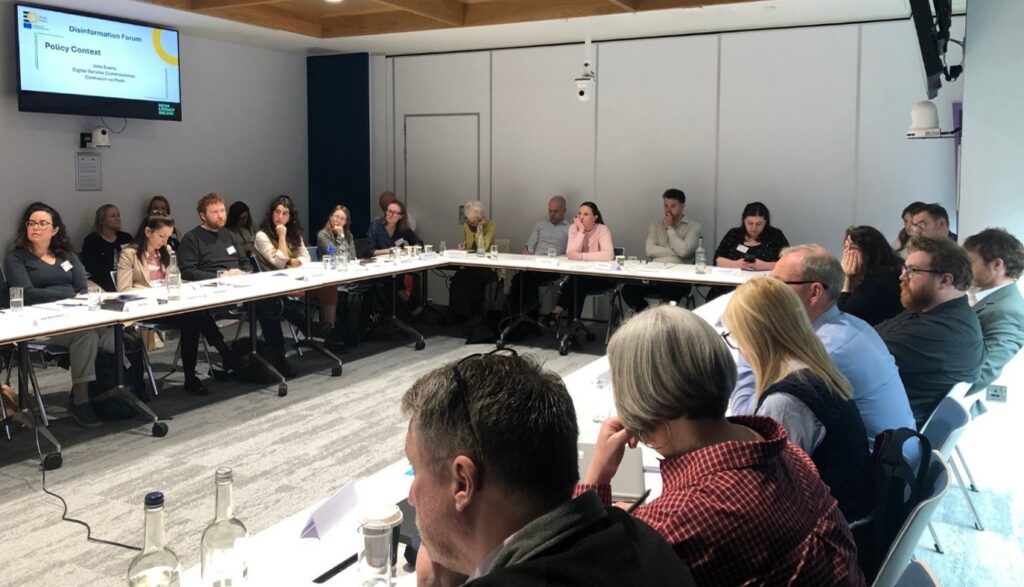
Collaboration is a key aim of the NCDS. To support that aim, this event was designed to bring together policy-makers, practitioners and grass-roots organisations to collectively explore both the impact of disinformation on the community and voluntary sector, as well as exploring how we might, collectively, use media literacy as one way of helping to build resilience to disinformation at a community level.
Disinformation is not a national issue, it is a challenge internationally and many approaches to countering disinformation involve international collaboration, especially at a European level, so it was very fitting that this Forum took place in Europe House, Dublin, kindly hosted by the European Parliament Liaison Office in Ireland.
The first part of the event focussed on a new EDMO Ireland Research Report entitled Disinformation Impacts on Community Organisations. Dr. Shane Murphy (DCU and formerly EDMO Ireland) presented the research, which highlights how disinformation undermines public participation and provides a basis for assessing media literacy needs within the community sector.
The research revealed that disinformation affects these organisations through multiple interconnected pathways, each presenting distinct challenges to their functioning and effectiveness. The themes capture the range of operational impacts that organisations reported experiencing, from broader societal perceptions to direct tactical pressures and internal organisational dynamics.
- Societal Distrust: Delegitimisation of the sector and its expertise
- Funding and Bureaucratic Pressures
- Direct Targeting and Staff Safety
- ‘Baiting’ Emails
- Internal Disruption
Conclusions from the report were that:
- The harm is cumulative: Distrust, harassment and internal disruption compound, eroding both the sector’s capacity and the public infrastructure it sustains.
- Service users absorb the cost : When organisations are forced to retreat or self-censor, the people who rely on their services are impacted first.
- The sector cannot defend itself alone: There are limits to how much the community and voluntary sector can achieve without support from policymakers, platforms, regulators, media and funders – and they are already stretched incredibly thin.
Shane was also joined for a discussion about the findings by Dr. Eileen Culloty (Associate Professor at DCU School of Communications, MLI Co-chair and EDMO Ireland Coordinator) and Colette Bennett (Policy Analyst with the National Economic and Social Council).
The full research report can be accessed here: https://edmohub.ie/index.php/new-report-on-disinformation-impacts-on-the-charity-and-voluntary-sector/
Disinformation is complex and countering it requires a range of measures, including legislative and regulatory levers. A lot of work has taken place at both European and national level to introduce legislation and regulatory measures to help counter disinformation while at the same time protecting core rights such as freedom of expression, privacy and data rights and media freedom and pluralism.
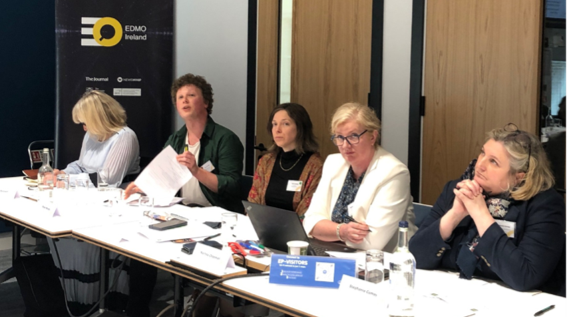
The second session of the event provided an overview of counter-disinformation policies and strategies with a media literacy dimension. Stephanie Comey (Director at Coimisiún na Meán, and MLI Co-chair) chaired the session and welcomed contributions from Seamus Hempenstall (Principal Officer in the Department of Culture, Communications and Sport), John Evans (Digital Services Commissioner for Coimisiún na Meán), Dr. Mary Clare O’Sullivan (An Coimisiún Toghcháin) and Diane Duggan (An Coimisiún Toghcháin).
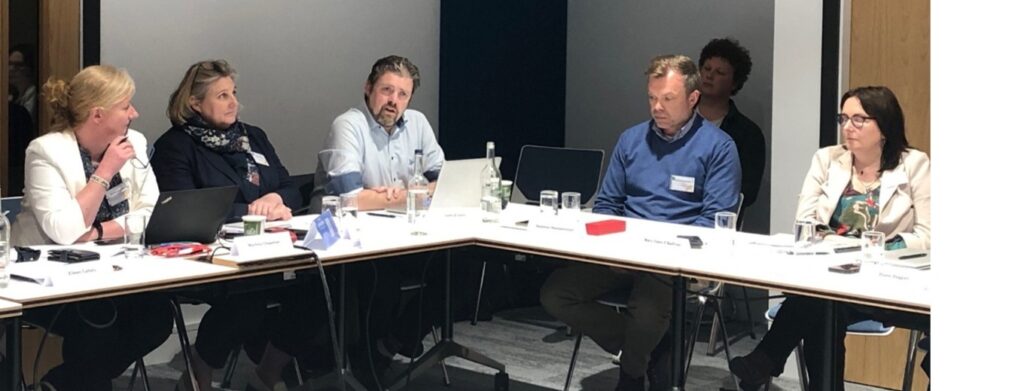
The focus then turned from policy to practice. Everyone is vulnerable to disinformation and so work to counter it must take many different approaches. Martina Chapman (National Coordinator, MLI) invited presentations of three case studies that explored how different approaches to developing and delivering media literacy related activities helped build resilience to disinformation for different audiences and also supported other cross-cutting themes such as social cohesion, adult literacy and democracy.
Robert McCulloch (Adult Literacy for Life Office, SOLAS) highlighted how the Adult Literacy for Life ‘Let’s talk about media literacy’ national campaign was designed to raise awareness that literacy is more than reading and writing and includes being able to make informed decisions about the media people engage with, being able to tell what is true or not and being able to ask questions about the information available, especially online. The campaign website can be accessed here: https://www.adultliteracyforlife.ie/medialiteracy/
Edel McGinley (Hope and Courage Collective) showed how the Hope and Courage Collective works with communities, workplaces and institutions across Ireland to strengthen democracy and build collective resilience in the face of rising far-right hate and disinformation. Through training, research and support, they help people stay grounded, resilient and connected as they push back against hate and division and create spaces where everyone can belong.
The four step Community Crisis Response Model was outlined, which is based on:
- Risk Assessment
- Crisis Intervention Response
- De-escalation Strategy
- Response Evaluation
More information about the Hope and Courage Collective is available on their website: https://hopeandcourage.ie/
Lorraine O’Connor (Community Education Officer, AONTAS) outlined how the Advocacy Team at AONTAS co-created the Community Education Against Disinformation (CEAD) Project workbook that supports community education participants’ development of competencies to ensure they can engage with digital technologies in a critical, collaborative and creative way.
The workbook can be accessed at https://www.aontas.com/wp-content/uploads/2025/10/CEADWorkbook_Design_WebVersion.pdf
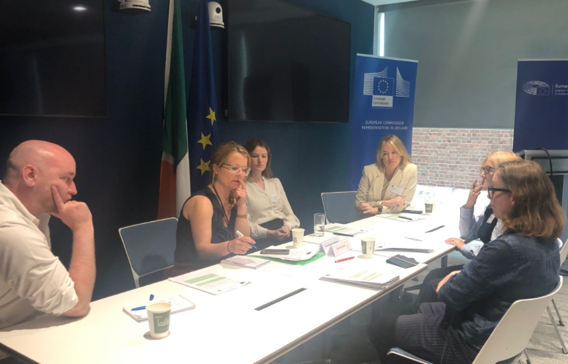
The day finished with a groupwork session designed to give participants an opportunity to work in small groups to share experiences and propose potential solutions to common challenges.
Participants were asked to answer two questions as part of a facilitated discussion.
Q1: Identify one immediate action and one long-term action that could help to foster media literacy, and in turn help to build resilience to disinformation in the community.
Q2: What tools, resources, partnerships and/or policy supports would need to be in place to help you make those actions a reality?
A positive point noted from the workshop outputs was that a significant number of the suggested actions are already either under way, or work is being undertaken to address these actions. It is clear that a significant amount of activity is already being undertaken by a broad range of actors to help counter disinformation via media literacy, but it is important that we work together to maximise potential and minimise duplication.