by Dr Rachel Farrell, Director, UCD Centre for Cyber Resilience Education
From passwords and personal data to fake content, cyber careers and AI, primary school children need more than online security warnings – they need the knowledge and confidence to understand the digital world.
Children already grow up in a world shaped by platforms, devices, data and algorithms. They use digital tools to learn, play, communicate and create. Technology supports engagement, collaboration and access to information. But it also raises real questions about privacy, trust, security and the skills children need to confidently navigate digital spaces. Recent important debates have rightly focused on technology in schools and the kinds of data it collects on children. But alongside asking harder questions about platforms, privacy and governance, we also need to ask are we doing enough to help children understand the digital world they live in?
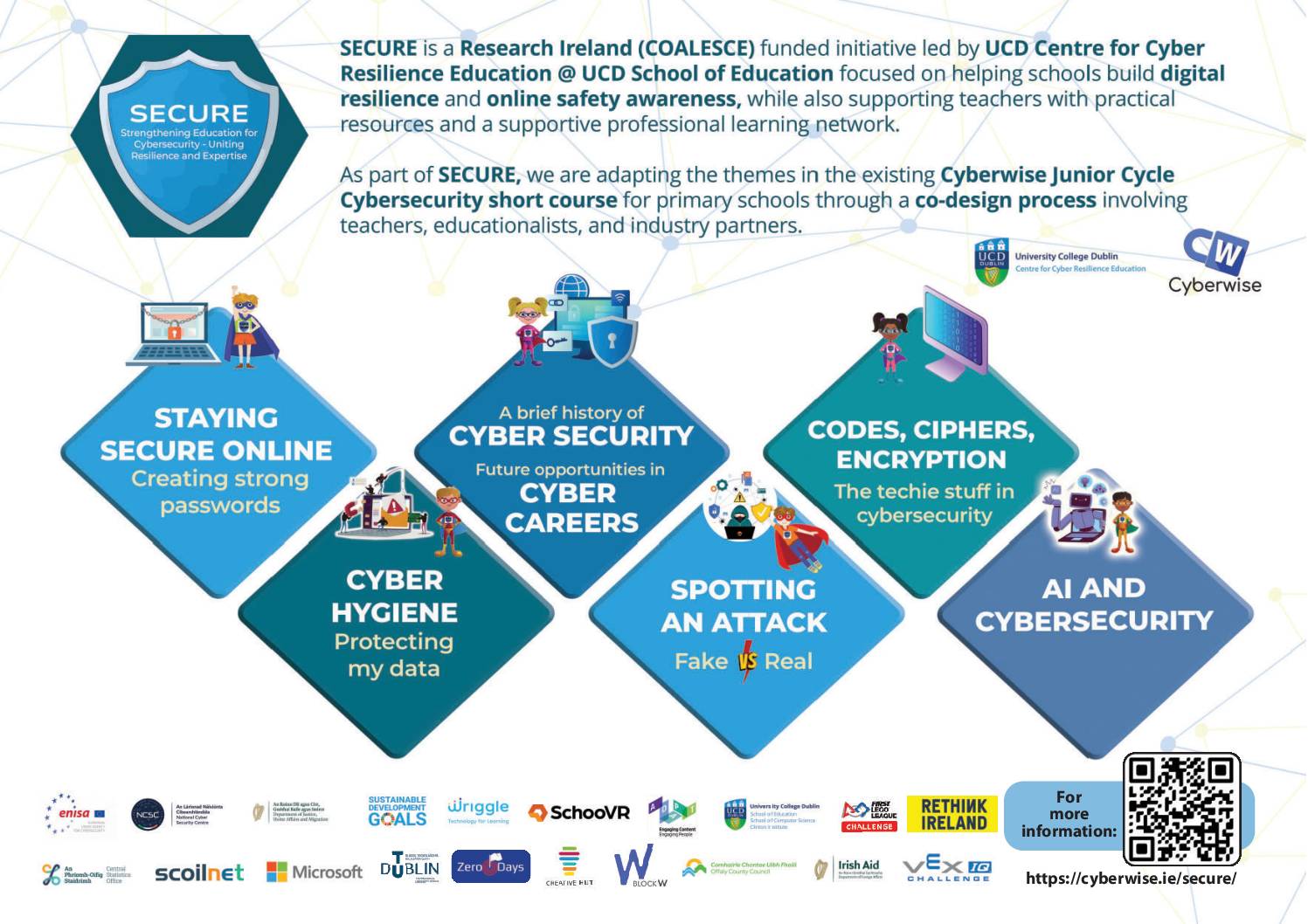
Cybersecurity education cannot wait until secondary school, nor should it be seen as the preserve of technical experts. It needs to begin in primary school, in practical, age-appropriate and empowering ways. That is the thinking behind SECURE, an initiative led by the UCD Centre for Cyber Resilience Education (cyberwise.ie) at the UCD School of Education and funded by Research Ireland’s COALESCE programme. The work is further strengthened by the involvement of contributors from education, government and industry, including NCSC, Oide Technology in Education, Cyber Ireland and BlocW. SECURE focuses on supporting primary teachers to build the knowledge, skills and confidence to introduce cybersecurity in meaningful, classroom-friendly ways.
Watch: SECURE explainer video
Listen: Midlands Radio interview
Find out more: SECURE website
The case for this work is straightforward. Cybersecurity is no longer a niche concern – it is part of children’s everyday lives.
For many adults, the word ‘cybersecurity’ can sound abstract, technical or intimidating. But for children, it can be made real through questions that already arise in their own experience. How do I create a strong password? Why does personal data matter? How can I tell if something online is fake? Who works in cybersecurity, and what do they do? These are not specialist concerns. They are part of learning how to live, learn and participate in a digital society.
Through SECURE, primary school children can engage with areas like staying secure online, cyber hygiene, protecting their data, understanding cyber events and careers, distinguishing fake from real content, exploring codes and encryption, and the links between AI and cybersecurity. These themes help children move beyond being passive users of technology, to better understanding the digital world in a critical way.
This matters because children need more than warnings. Too often, online safety education is reduced to messages of risk and restriction: do not click that, or do not share this. Those messages have their place, but children also need opportunities to ask questions, solve problems, and understand why secure online behaviour matters. Cybersecurity is not only about threats. It is also about resilience, judgement, and critical thinking.
There is another important benefit to early cyber education. It can help broaden children’s sense of who belongs in this space. When children encounter cyber concepts in engaging and accessible ways, they begin to see that cybersecurity is not just for industry insiders. It also involves creativity, teamwork, communication, ethics and curiosity. Introducing cyber careers in primary school can help challenge stereotypes and open up possibilities that some children might never imagine for themselves.
Fun, hands-on learning is at the heart of SECURE. Through initiatives such as Creative Hut Ireland/First Lego League, SECURE helps children develop the hard skills of coding, computational thinking and problem solving, and the soft skills of teamwork, creativity, communication and innovation – all essential in the digital world. Shared learning events strengthen this further, bringing children, teachers and schools together to showcase and celebrate learning.
A major milestone was the capstone shared learning event held at the new O’Connor Centre for Learning at UCD on 12 June for schools. SECURE events like this give children a chance to present, collaborate and celebrate what they have learned, They also demonstrate that cyber education can be creative, inclusive and engaging. See more: shared learning event photos and video
Teachers are central to this work, and one of SECURE’s key strengths is recognising they do not need to be experts to teach these ideas. They just need accessible resources, relevant professional learning and confidence. From September, an open-source professional learning course will be available to all teachers through the iTEN platform. This extends the reach of SECURE beyond the schools directly involved in the initiative.
There is also a broader democratic issue at stake. If children are growing up in increasingly digital environments, education must do more than place technology in front of them. It must help them understand the systems shaping their lives. That includes questions of data, privacy, trust, and the wider social implications of technology. In that sense, cyber education is about agency, not just protection.
We should want children to be safe online. But we should also want them to be informed, capable and confident. Not simply passive users of digital tools, but active and critical participants in digital society.