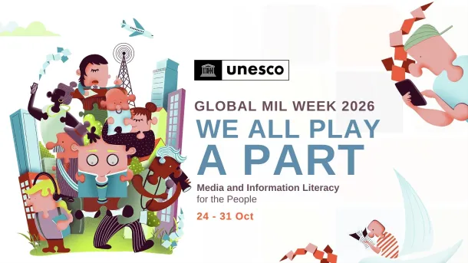
Global Media and Information Literacy Week returns on 24 October 2026, and Media Literacy Ireland wants people across the country to take part.
The annual event, which raises awareness of media and information literacy (MIL) and runs until 31 October, is hosted by United Nations Educational, Scientific and Cultural Organisation (UNESCO). The theme for this year – #WeAllPlayAPart: Media and Information Literacy for the People – aims to unite people around the world to help build a stronger information ecosystem.
Figures provided in the UNESCO brief, Media and Information Literacy for All: Closing the Gap, show the scale of the task. The 2025 report details how only 43 percent of countries have integrated MIL into their curricula, and just 17 of the international body’s 194 member states have adopted a dedicated standalone MIL policy. Meanwhile, 52 percent of 18–24-year-olds rely on social media, video platforms and AI chatbots as their main source of news. Seven in 10 people believe journalists deliberately mislead the public.
The message from UNESCO in 2026 is that in an age shaped by AI, digital platforms and information overload, everyone has a role to play in helping people navigate information critically, confidently and ethically, and UNESCO has a range of resources and activities to help. Educators can draw on the UNESCO Media and Information Literacy Curriculum. It offers a competency framework and practical modules linking MIL to AI, digital citizenship and misinformation.
Families are also an important starting point, as MIL begins long before young people reach adulthood. Regular conversations about online experiences, social media and AI help children build confidence and critical thinking. Launched earlier this year, UNESCO’s Growing Up in a Connected World is a global family guide designed to equip parents and caregivers with MIL skills to help children navigate digital technologies safely and critically.
For young people who want to get involved, the UNESCO Youth Hackathon 2026, themed Play Your Part: Youth Designing the Future of Media and Information Literacy, is running online until 28 November.
Creators have growing influence, with 46 percent of people now getting news from digital content creators. UNESCO’s Behind the Screens study of 500 influencers in 45 countries found that fact-checking is not the norm and that many creators struggle to judge the credibility of what they find online. The vast majority said they want MIL training.
Journalists and media organisations also have an important role by fostering trust through transparency and quality journalism, while regulators such as Coimisíun na Méan can help to embed MIL in education, digital governance and public policy.
During the week, stakeholders around the world organise events, and UNESCO is co-hosting regional and flagship events across multiple countries to bring the MIL community together.
Media Literacy Ireland encourages schools, libraries, community groups, businesses and individuals to mark the week in their own way. You could talk with your family about what you see online, check a source before sharing it, or run a session in your classroom or workplace. There are lots of resources on the MLI website to help you.
Share your activities using #WeAllPlayAPart and help build a stronger information ecosystem for everyone.