MIL-CC (Media and Information Literacy Community Connections) is pleased to announce that its media literacy training programme for public librarians is now freely available in English and Spanish.
MIL-CC was a pilot project running in Ireland, Spain and Portugal, exploring how best to design and deliver media literacy training for public librarians. Funded by the European Media and Information Fund and supported by public library authorities in each country, the project addressed the urgent need to upskill librarians with media literacy skills. It was coordinated by the University Institute of Lisbon (Iscte) in partnership with Learn to Check (Spain) and DCU FuJo (Ireland). Media Literacy Ireland was proud to support the project alongside Local Government Management Agency (LGMA) in Ireland; the Portuguese Directorate-General for Books, Archives and Libraries (DGLAB); the Portuguese Association of Librarians (BAD); and the Spanish Society of Scientific Documentation and Information (SEDIC).
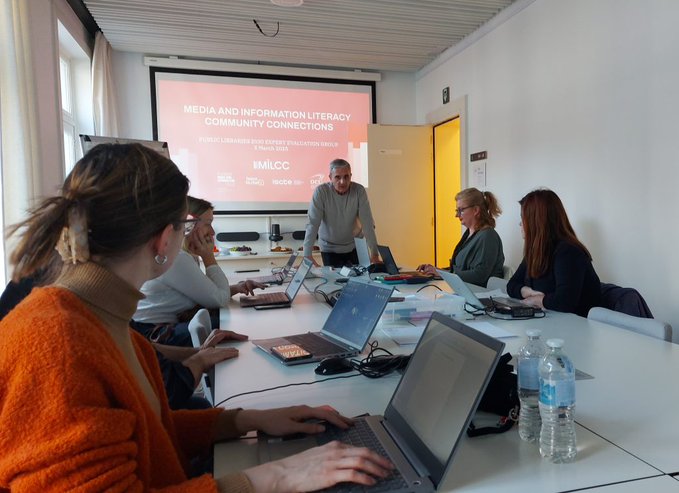
Public libraries play a crucial and trusted community role as venues for lifelong learning and social integration. However, librarians often lack tailored resources or training on media literacy. The core aim of MIL-CC was to develop a practical, relevant training programme that increases public librarians’ knowledge and understanding of media literacy; builds librarians’ confidence to curate events and engage with the public on media literacy topics; and adapts to the realities of library work, including limited time, diverse audiences and low-tech environments.
This comprehensive training programme consists of four modules designed to build librarians’ knowledge, skills and confidence so they can commission, curate or deliver media literacy events in their libraries. A key feature of this training programme is its low-tech design, making it flexible and accessible for librarians across diverse contexts. The topics covered include:
Module 1 – Introduction to Media and Information Literacy
Module 2 – Teaching Media and Information Literacy
Module 3 – Developing MIL Activities
Module 4 – Implementation, Review and Evaluation
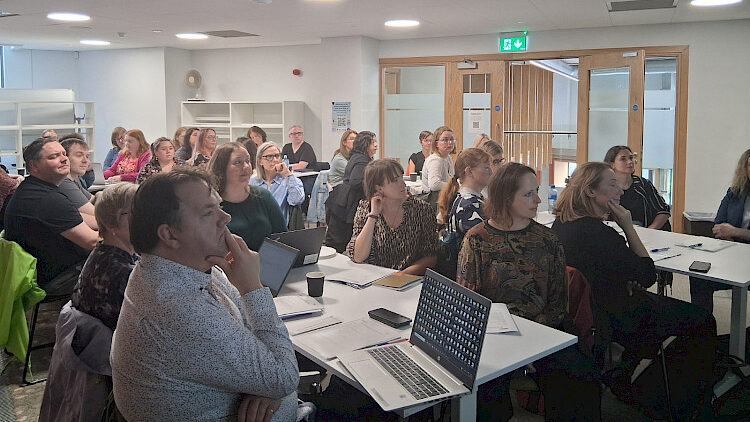
MIL-CC project results in Ireland
The target for the Irish element of the project was to train 50 librarians who would work (preferably in pairs) to develop and deliver 25 MIL projects specifically for their local communities.
At the end of the course, 57 library staff participated in the training, representing 44 libraries in 23 counties. At least 26 projects had been developed reaching over 900 participants. Collaboration was a key feature, with 95% of projects developed in partnership with other librarians or with third-party organisations including many with Regional Literacy Coordinators and Skills for Life Coordinators. Most importantly, 80% of the librarians who responded to the feedback survey have plans to develop and deliver more MIL projects.
What the participants said
“The course provided a comprehensive introduction to media literacy training. The range and quality of resources and supporting documentation, combined with the expertise of the trainers, enabled us to effectively plan and deliver our own initiative. The lectures were highly engaging and offered valuable opportunities to connect with library colleagues from other local authorities, allowing for meaningful discussion of project ideas and methodologies. There was a strong sense of shared expertise, experience and knowledge throughout the programme. Running the course over a number of months helped to maintain momentum, while also alleviating initial nerves and significantly increasing our confidence.”
“Very beneficial and I found the recommended resources a huge help and guidance for when we were creating our own Media Literacy Project. I believe my colleague and I have more knowledge and confidence to deliver more Media Literacy workshops. I believe the connections we have made with other students of the course will also act as a guide for future projects.”
“The course provided a strong foundation for facilitating media literacy discussions. It offered practical insights that will help me guide library users in thinking more critically about the media and information they encounter.”
The resources included in the project are free to use, not just by librarians but by any community leader. When using these materials, please credit the project as follows: This training programme was developed as part of the MIL-CC (Media and Information Literacy Community Connections) project, funded by the European Media and Information Fund and coordinated by University Institute of Lisbon (Iscte) with Learn to Check and Dublin City University.”
To find out more and to access the resources, visit the DCU FuJo site